Faith Journaling 101: How to Hear God Through Writing

Faith journaling is an underutilized spiritual discipline that can help you hear from God. It’s not meant to take the place of reading or studying your Bible, but it’s a great addition to your daily or weekly time with God.
While here at Fine Natural Hair and Faith, the goal is to provide you with hair care tips and guidance specifically designed for fine natural hair, I don’t want to overlook the importance of feeding your faith as well. You’ll find all of my faith-based articles here.
Now, onto faith journaling, also closely associated with scripture journaling and sometimes referred to as spiritual journaling…
What Faith Journaling Is All About

Faith journaling is just writing down thoughts and reflections related to your walk with God.
This can include:
- What you’re reading about or studying in the Word
- Things you’re praying about
- Anything that comes up during your prayer time
- Something you sense God may be saying to you
- Questions you have about your faith or something you’re studying
- A record of how God has answered your prayers
This can also look like writing out a verse of scripture along with what it means to you or jotting down a thought that came to mind while you were reading your Bible.
It’s easy to confuse this with scripture journaling, and the two can overlap. However, scripture journaling usually centers on a specific verse or passage in the Bible that you’re reading or studying.
Faith journaling is a little broader. It can include Scripture, prayer, reflection, gratitude, questions, and other parts of your relationship with God.
Neither one replaces reading your Bible. Both are ways of slowing down, paying attention, and fine-tuning your spiritual ears to hear from God.
How Writing Can Help You Hear from God
I’ve found that when I write things down, it’s easier to remember them. It’s like they’re imprinted in my mind.

Reading a verse and moving on is different from reading it and then writing out what stood out to me.
The second one slows me down enough to actually think about what I read instead of just checking a box that says, “I’ve read the Bible today.”
Habakkuk 2:2 says to write the vision down and make it plain.
There’s something to that.
Writing forces clarity. It also gives you a record of what you were reading, praying about, and thinking about during a particular season of your life.
Months or even years later, you can look back and see the verses—or a particular word from Scripture—you were reading and studying.
You can revisit prayers you once prayed.
You can see how God answered some of those prayers.
You may even notice patterns you couldn’t see while you were living through them.
That’s one of the things I appreciate most about keeping a faith journal: you’re not only documenting what you’re thinking today. You’re creating a record of your spiritual life that you can return to in the future.
What You Need to Start Faith Journaling
You don’t need anything special to begin faith journaling. Start with the basics:
- a Bible
- Notebook
- Pens (a red and a black or blue)
- a highlighter
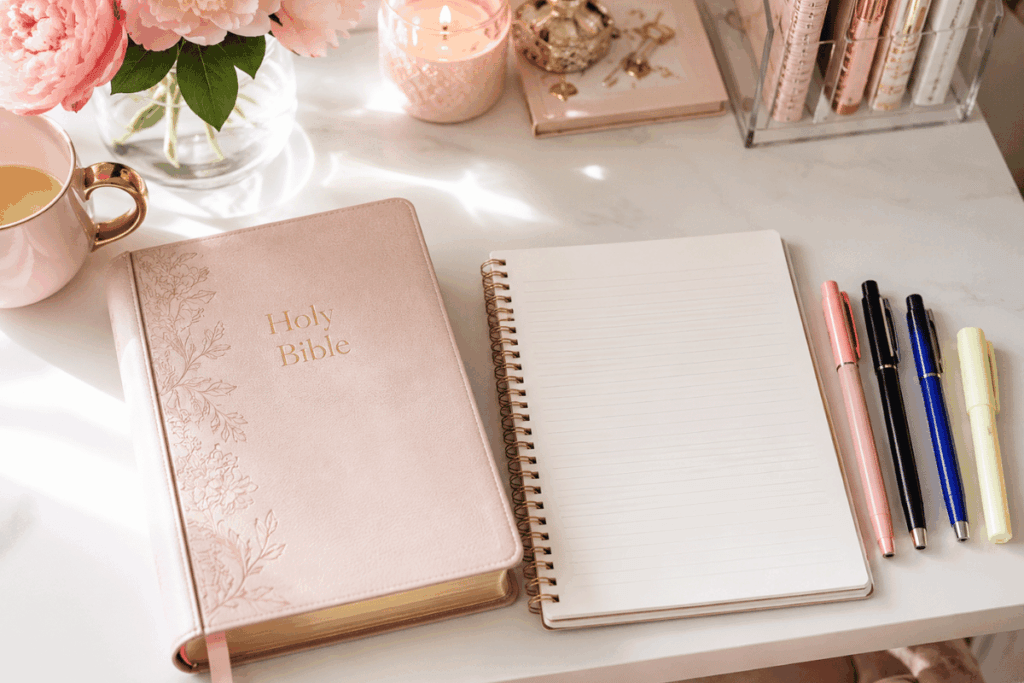
That’s really it. What matters more than the supplies you use is finding dedicated time when you’re not rushing to get somewhere else.
Some people prefer a dedicated Christian faith journal with prompts already built in, and that’s fine too if it helps you get started. But it’s optional. You can begin with a plain notebook and the Bible you already own.
A Few Ways to Approach Spiritual Journaling
You may find one method that works especially well for you, or you may move between different approaches depending on what your time with God looks like on a given day.

Here are a few ways to get started with Christian journaling or Bible journaling.
1. Use The SOAP Method
With the SOAP method, you:
- S — Write out the Scripture
- O — Observe what you just read and wrote
- A — Determine how it Applies to your life
- P — Pray through it
SOAP is a Bible study method, but it’s also a good starting point for faith journaling if you’re not sure what to write. So, instead of staring at a blank page waiting for inspiration to strike, you can use this as a simple framework to help you get started journaling with God.
2. Try Prayer Journaling
With prayer journaling, you simply write out your prayers.
You can write in full sentences or use bullet points. You’re not necessarily praying aloud, although you can certainly write and pray aloud at the same time.
This method can work especially well if your mind tends to wander during prayer. Writing gives your thoughts somewhere to go. It can also help you slow down enough to recognize what you’re actually thinking, feeling, or asking God for.
3. Give Scripture Journaling a Try
When journaling out the scriptures, it’s as simple as copying out a verse or passage by hand and then writing what it means in your own words. It’s a method of Bible journaling that’s focused specifically on writing out text from the Bible along with your reflections.
You can ask yourself:
- What stands out to me?
- Is there an instruction I need to follow?
- What does this passage teach me about God?
- Is there a promise I need to memorize?
- Is there something here I need to pray about?
This is something you can easily incorporate into your regular Bible study time.
4. Keep a Record of Answered Prayers
Part of faith journaling can be writing out a prayer and updating in your journal how and when God answered that prayer. You can keep a running list of what/who you’ve prayed for and the specific outcomes. Try one of these methods at a time or move between them depending on what your time with God looks like on a given day.
How to Hear God While You Write
When you decide to faith journal, your biggest concern probably isn’t how to put pen to paper but how to actually hear from God as you write.
To be very transparent, hearing from God isn’t something you can dictate. There’s no guarantee you will hear some earth shattering message every time you decide to journal.
What faith journaling does is it positions you to hear from God. As you read His Word, you may hear the voice behind the word because the Word of God is living and it’s powerful.
You may hear the Holy Spirit speak to you as you are writing out your prayers.
You may feel led to do something or stop something.
The possibilities of what you “hear” are endless. The key is to start with an open heart, praying to God to also open your (spiritual) ears to hear.
Start with prayer before you write a single word. Ask God to open the eyes of your understanding. Then write without editing yourself.
If something comes to mind while you’re writing, write it down, even if you’re not sure yet where it’s from.
A Word of Caution About Hearing From God
Not everything you hear may come from God. Test everything against the Holy Scriptures. If what you believe you heard aligns with Scripture and with what the Bible reveals about God’s character, you can continue to pray about it and seek wisdom.
If it contradicts Scripture, reject it. God will never contradict His Word.
Hindrances to a Consistent Journaling Practice
A few things tend to stop people from engaging in a practice of journaling their faith as a spiritual discipline. These can also prevent you from getting real value from the practice:
- Expecting a dramatic experience. Most of what you may hear from God is quiet. It can be a single word or nothing at all. If you’re waiting for the sky to light up, you’ll miss the whole point.
- Trying to write perfectly. There’s no wrong way to write a prayer or a thought down. Cross things out if you need to. Leave sentences unfinished. It’s a journal, not a manuscript. Some people prefer a dedicated Christian journal with prompts already built in. If that helps you continue to write, by all means use one.
- Only journaling when life feels hard. Faith journaling is one of the most fulfilling spiritual habits you can build. It’s not just for the difficult moments in life. It’s for the everyday moments. Plus, when you are used to journaling regularly, it becomes that much easier to do when times are hard. Plus, you will have created a valuable record of your spiritual life that you can refer back to in the future.
Faith Journal Prompts to Get You Started
If you find yourself staring at a blank page, wondering how to get started with faith journaling, try one of these prompts:
- What is one thing God has shown me this past week?
- Where am I struggling, and what verses of scripture promise to help me overcome?
- What or who am I currently praying for?
- What are my goals in life? What scriptures can I rely on for wisdom?
- What am I grateful for today that I haven’t expressed out loud?
- What areas of my life do I need to trust God more in?
- If God answered one prayer today but not in the way I expected, what would I need to let go of to recognize the answer?
Pick one, pray before you start, set a timer for five or ten minutes, and just write.
How to Make Journaling Part of Your Time With God
To make faith journaling a part of your regular time with God, there are a few things you can do:
- Attach it to something you’re already doing, like reading your Bible in the morning, having a cup of coffee, or incorporating it into your morning routine
- Keep your journal in a place you’ll see it regularly. If you pray before bed, keep it on your nightstand. If you have a prayer room you go to every morning, keep it there
- Set a reminder. Just like you schedule time for other things, you can schedule time to journal
- Make it pretty. If you’re anything like me, you are drawn to pretty things. I like beautiful notebooks and stickers. Being drawn to them makes me use them more often.
Some weeks, you’ll want to write every day. Other weeks, you may only write a few days. Both are fine. What matters is making it a habit that you come back to again and again.
If you’re new to spending intentional time with God beyond Sundays, faith journaling is a great way to spend more time in His presence. Grab a notebook, open your Bible, and write down what you notice. That’s really all it takes to begin.
Keep Building Your Time With God
10 Christian Journaling Ideas
Feeding Your Faith God’s Word
Becoming a Proverbs 31 Woman in Today’s World