The Minimalist Fine Natural Hair Starter Routine — A Beginner’s Guide

Key Takeaways
- Fine natural hair needs a unique approach due to its smaller strand diameter and quicker moisture loss.
- A minimalist natural hair care regimen should consist of five essential components: a gentle shampoo, a deep conditioner, a lightweight leave-in, one or two lightweight stylers, and one lightweight oil.
- Avoid heavy products that lead to buildup, and focus on a simple regimen to better understand your hair’s needs.
- Building a regimen involves consistency and paying attention to how your hair responds to products and methods.
- Using fewer products helps prevent overwhelm, promotes effective care, and supports healthy, thriving fine natural hair.
Does this sound familiar?:
You found a natural hair Facebook group…and joined
YouTube sent you down the rabbit hole and you watched seventeen videos.
You also added twelve things to your shopping cart.
And somehow, you still don’t know where to start.
That’s a common problem those of us with fine (and lower density) hair tend to happen. It’s also a common thing that trips up fine natural hair care for beginners.
The natural hair world is largely built around thick, dense, coily strands. You know the ones. Type 4 super thick strands.
The advice, product recommendations, and multi-step routines weren’t necessarily meant for us. And when fine-haired women follow that advice, they end up with weighed-down, flat, hair that only ends in frsutration frustration.
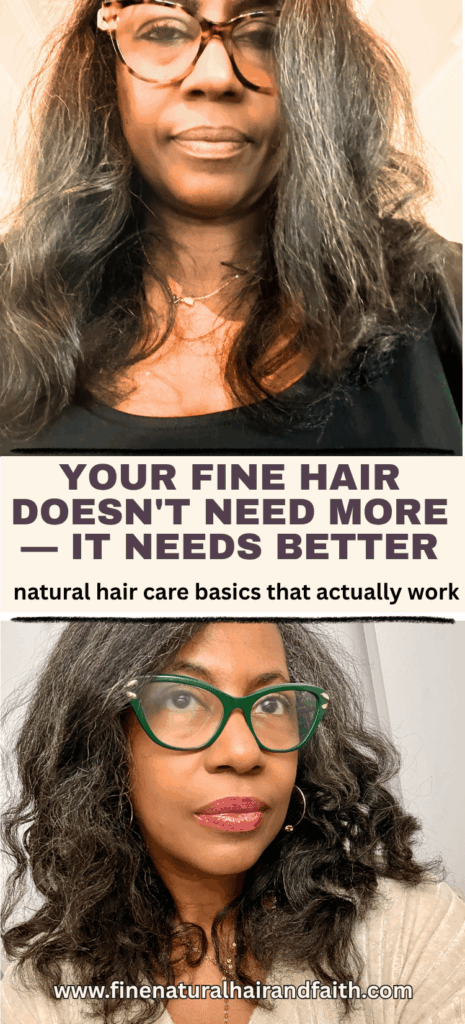
Here’s what I’ve learned about fine natural hair after living with it myself for many years: less is almost always more. The minimalist natural hair care routines for fine hair that I’m about to share aren’t a compromise. They’re the strategy. [See Faith-Based Natural Hair Framework — Identity stage]
Why Fine Natural Hair Needs a Different Approach
Fine hair has a smaller strand diameter than other natural hair types. That single fact changes everything. What fine natural hair actually needs is vastly different than that of those with heftier strands.
It means your strands absorb moisture quickly but lose it just as fast. Fine hair is also more prone to product buildup, weighing your hair down and stealing the volume and movement every natural girl loves. The more products you layer on to your hair, the more your hair seems to work against you – at least how it looks.
A Starter Routine for Natural Hair
The goal of having natural hair starter routine isn’t to replicate what you see on someone with a different hair type. The goal is to understand what your specific hair type needs and to give it exactly that, nothing more.
That’s the foundation of what I call a stewardship approach to hair care. [See my Faith-Based Natural Hair Framework]
The Five Essentials of a Minimalist Fine Natural Hair Regimen
Your complete hair regimen which is the totality of everything you do for your hair — only needs five core components to be successful. Here they are.
1. A Gentle Shampoo
Everyone needs a shampoo to cleanse their hair, regardless of hair characteristics. Some opt to use conditioners to cleanse, but conditioners just add a coat to the outer layer of the hair, not fulling cleaning it or removing product residue.
Since fine natural hair builds up product residue faster than most, cowashing should be severely limited. You need a gentle shampoo that you use on fregular wash days but formulated in a way that it can also clarify your hair when needed. This is your first non-negotiable product.
Look for sulfate-free formulas that don’t leave a coating on the strand. Avoid shampoos marketed for “moisture” as your everyday cleanser. The moisturizing agents in many of these shampoos accumulate quickly on fine strands and create the heavy, limp feeling you’re trying to avoid.
A light, clean rinse is what you’re after. Plan to clarify (a deeper cleanse to remove buildup) at least once a month, more often if you’re using heavier stylers. This is when you can actually benefit from having a clarifying shampoo in your stash as well.
2. A Deep Conditioner (Ideally With Light Protein)
Every wash day needs a deep conditioner — full stop. This is what provides your hair with deeper hydration so it can retain moisture longer between wash days. For fine strands, look for a formula that includes a light protein. Fine hair is more prone to breakage, and protein helps maintain the integrity of your strands over time.
One important note for those with low porosity hair: protein isn’t required as often, and the type of protein used matters (Here’s a comprehensive list of the different types of proteins used in hair treatments from Neno Natural and the type of hair each is best used for.
Heavier proteins can cause stiffness and breakage on low porosity strands. If you’re not sure of your porosity, check out that article.
Still trying routines that just don’t work for you? Discover your Faithful Strand and finally understand why. 👉 [Take the Faithful Strand Quiz]
3. A Lightweight Leave-In Conditioner
A leave-in conditioner is the bridge between your wash day and the days that follow. For fine natural hair, look for liquid leave-ins or leave-in sprays rather than creams. Aloe-based or water-based formulas are your best friends here.
Avoid leave-ins that are heavily formulated with oils. They’ll just sit on the hair shaft instead of penetrating it, again….leading to product buildup and that flat, weighed-down feeling.
Kinky Curly Knot Today is a well-known option that works well for fine natural hair.
Whatever you choose, start with less than you think you need. You can always add more product.
See A moisturizing routine for fine natural hair
4. One to Two Lightweight Stylers
This is where the natural hair space will try to sell you everything from curl creams to curl soufflés to twist-and-seal butters. For a minimalist fine natural hair regimen, you need one to two stylers. No more. There’s no need to complicate this.
If you don’t wear your hair in its naturally curly state, you can get away with one styler but if you do rock your natural curls, then you may need another to provide your hair with some hold.
A lightweight gel (flaxseed gel being my number one recommendation) and/or a water-based curl cream is usually the sweet spot for fine natural strands. The rule of thumb: choose the lightest-weight formula that delivers the definition you’re after. Bonus points if that style also provides you with some hold.
If your styler leaves your hair crunchy, stiff, or flat by day two, it’s too heavy.
5. One Lightweight Oil
A single lightweight oil is one of the most versatile tools in a minimalist natural hair regimen. Use it to seal moisture into your strands after your leave-in on wash day. Then, use it to lubricate your hair several nights throughout the week.
Think jojoba, argan, or sweet almond oils. These all absorb well into the hair. Skip the heavier options like castor oil and shea butter as daily-use products on fine strands. Save those for targeted (think the ends of twists), occasional use only.
What You Can Skip (For Now)
Part of building a natural hair starter routine that you’ll actually use consistently is knowing what to leave out.
Heavy butters and oils as daily moisturizers. Castor oil, shea butter, and similar products are favorites in the natural hair community, but on fine hair when used regularly, they build up fast and can flatten your hair out. If you love them, use them sparingly and strategically, not for daily use.
A ten-step wash day. Pre-poo, steam treatment, protein treatment, deep conditioning, leave-in, curl cream, gel, oil, and two more things — this works for some hair types. For fine natural hair just starting out, it’s a fast track to overwhelm and product buildup. Build your foundation first.
Every product your favorite creator uses. Not that I’m into the hair typing system but for reference, If she has thick, 4C strands and you have fine, 3B strands, her entire product shelf may not translate for your hair. Watch the techniques but be selective about the products used.
Trimming on a Schedule. Noticed I didn’t mention anything about trimming. That was intentional. You can start by getting a professional trim if you like but I think it’s important that we all learn how to take care of our own hair and trimming should only be done as needed. If you are not doing all of the things that cause damage to fine strands, then trimming will be infrequent.
Building Your Simple Natural Hair Regimen
Minimalist natural hair care routines for fine strands look something like this in practice:
Wash day (once a week or every ten days):
- Shampoo
- Deep Condition
- Apply a Leave-in
- Use a Styler
- Seal with an oil
That’s just five products and a process you can learn, refine, and trust over time.
Between wash days:
- Refresh curls with a light leave-in spray.
- Use a lightweight oil to lubricate strands a few nights a week.
- Protect your hair at night with a satin scarf or bonnet.
The simplicity is the point. When you use fewer products, you learn what each one is actually doing. You start to understand your hair better and how it responds to things like humidity, protein, water, and manipulation. That knowledge is what no product can give you.
This is what I mean when I talk about the Stewardship stage of caring for your natural hair: it’s not about having the right ten products. It’s about learning what your hair needs and honoring that consistently. [See The Stewardship Stage of The Faith Based Natural Hair Framework]
One More Thing About Fine Natural Hair and “Simple”
Simple doesn’t mean careless. A minimalist natural hair regimen still requires consistency, intention, and a willingness to pay attention to what your hair is telling you.
What it removes is the noise:
- The pressure to keep up with every trend.
- Constant product-hopping.
- That feeling that you must be doing it wrong because you’re not using what everyone else is using.
Your hair was made to be cared for, not overwhelmed. And the right routines for you are the ones that are simple enough to do faithfully, and targeted enough to actually work.
If you’re not sure where your hair is starting from or what it needs most right now? That’s exactly what the quiz below is designed to help you figure out.
→Don’t forget to Take the Faithful Strand Quiz to find out your strand type and get a personalized starting point for your regimen.
Frequently Asked Questions
Q: What products do I need to start a minimalist natural hair routine?
Regardless of hair type, to start a minimalist natural hair routine, you’ll need the basics: a gentle shampoo, a deep conditioner (bonus if it has a light protein in it), a leave-in conditioner that’s not heavily formulated with oils (Kinky Curly Knot Today works well for fine hair), one styler suited to your curl pattern, and one lightweight oil that can double for sealing moisture into your hair and lubricating it several nights throughout the week.
Q: Why does my fine natural hair feel weighed down after I moisturize?
Moisture comes from water. It’s when you add heavy creams, butters, and oils to your hair after moisturizing that buildup occurs — especially on fine strands. Switching to lighter, water-based formulas usually resolves this.
Q: How often should I wash fine natural hair?
This is very dependent on how much product and/or oils you use on your hair throughout the week. For fine-haired naturals, an optimal timeframe for wash day is between weekly to every ten days. If you use a lot of product, you may need to wash more frequently — but it’s best not to use a lot of product on fine strands because you’ll only create buildup faster.
Q: Do I need a deep conditioner if I have fine natural hair?
Yes. Your deep conditioner is what hydrates your hair to retain moisture longer. Whenever you wash your hair, it’s important to deep condition. In addition to your deep conditioner, you’ll need to use a protein treatment at least once monthly to maintain the integrity of fine strands. For those with low porosity hair, protein isn’t required as often and the type of protein used matters.
Q: What’s the difference between a natural hair regimen and a routine?
Your hair routines make up the totality of your natural hair regimen. To care for your hair, you’ll have different individual routines — like your moisturizing routine, wash day routine, straightening routine, styling routine, etc. These are the individual components that make up your hair regimen.