What Fine Natural Hair Actually Needs — A Regimen Built for Your Strands
If you have spent any real time in natural hair spaces online, you already know the frustration. You follow the steps. You buy the products. You watch the tutorials. And somehow your hair does not respond the way it does in the video.
Here is what nobody told you: building a natural hair regimen for fine strands requires a completely different approach than what dominates the natural hair space online. Most of that content was not made for your hair.
Not because the creators do not know what they are doing. They absolutely do, for THEIR hair. The issue is that fine natural hair behaves differently from medium and coarse textures, and the advice circulating out there was never designed with your strands in mind.
This is one reason I created The Faith Based Natural Hair Framework – to provide ladies with a clear path to understanding their natural hair in a way that nobody else is talking about.
What Makes Fine Natural Hair Different
Before you begin to even start building a natural hair regimen for fine strands, it’s important to understand this naturally fragile hair type.
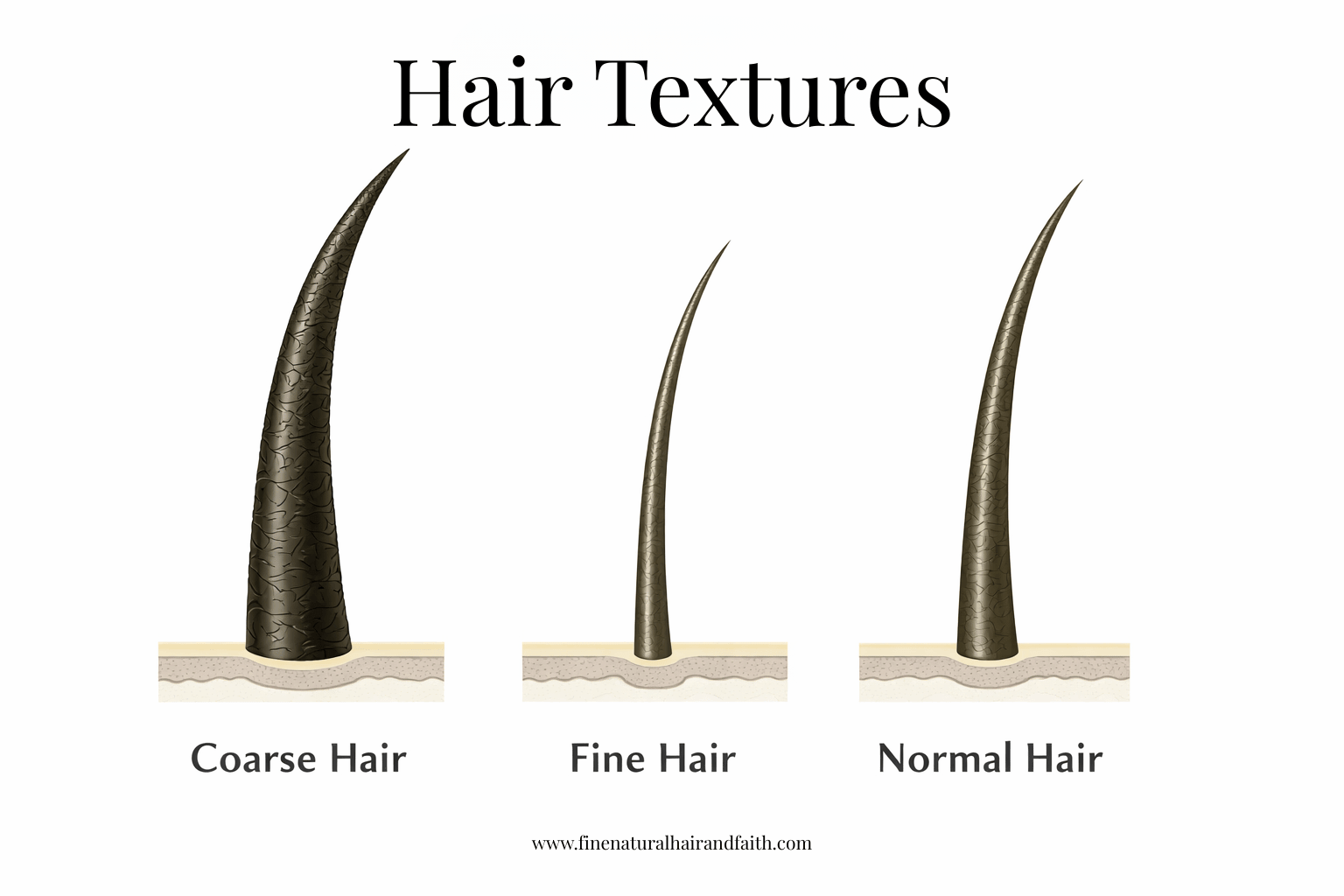
First off, fine natural hair refers to the diameter of each individual strand – not how much hair you have on your head. It’s entirely possible to have fine strands and appear to have thick hair.
As the American Academy of Dermatology notes, knowing whether your hair is fine or coarse should directly guide the products you choose and how you build your regimen.”
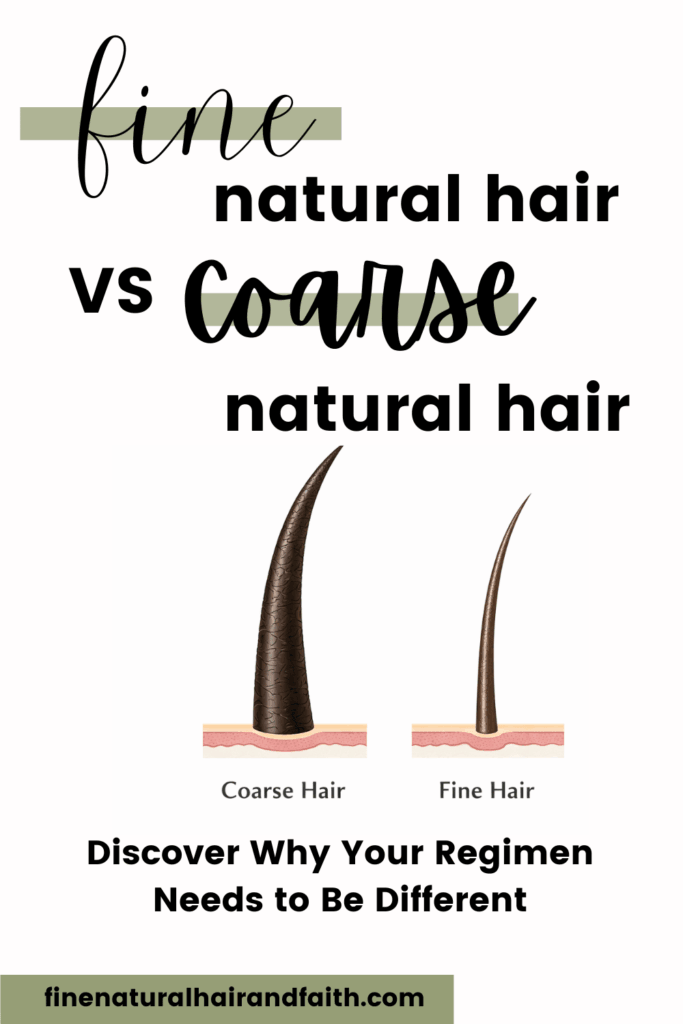
Fine strands are thinner in circumference than medium or coarse strands, and that one difference changes everything about how your hair responds to products, techniques, and the individual routines that should make up your regimen.
For those of us with fine strands, you may recognize how our hair is different. Fine strand:
- weigh down faster
- absorb moisture differently
- are more prone to product buildup.
- can appear limp when over-moisturized and brittle when under-nourished.
The margin for error is smaller, and the standard advice of using more product, adding more moisture, and basically doing more of everything, can work against you completely.
This is not a problem with your hair. The problem is with your routines.
Why Popular Natural Hair Advice Misses the Mark
There’s a lot of advice for natural hair floating around out there. Let’s take the LOC method. For many naturals with medium to coarse strands, layering a liquid, oil, and cream works beautifully. For those of us with fine natural hair, that same combination can mean weighed-down, lifeless hair before the day is over. It’s not because the method isn’t effective for moisturizing hair. It’s because that moisturizing routine isn’t the greatest for your hair’s weight capacity.
The only exception that I make is during the winter when I’m wearing my hair in a protective style where volume isn’t a concern.
Then, there’s deep conditioning. The general guidance is that more product and more time with product in your hair is better.
For fine natural hair, too much protein (or the wrong type of protein used) in your strengthening routine can cause brittleness. Too much moisture in your moisturizing routine can leave your hair unable to hold any definition at all. Balance matters far more than volume.
The individual routines that make up your regimen are not the problem. The mismatch between those routines and your actual texture is. And that is exactly what most natural hair content never addresses.
Building a Natural Hair Regimen for Fine Strands
Less. Seriously.
Fine natural hair thrives on simplicity:
- Fewer product layers
- Lighter formulas
- Less manipulation
When you are building a natural hair regimen for fine strands, the goal is not to load your hair up. It’s to give it exactly what it needs and nothing more.
A few principles worth keeping in mind when building your regimen:
Prioritize clarifying. Fine strands accumulate buildup faster than any other texture. A clarifying wash is not optional, especially if you use a lot of styling products. If your hair feels weighed down or dull, start here before adding anything new.
Choose lightweight formulas. If a product feels heavy in your hand, take a beat before it goes anywhere near your hair. Heavy products are not your friend, and they will work against every other step in your regimen.
Watch your protein and moisture balance closely. Fine natural hair is sensitive to excess and deficiency across your strengthening and moisturizing routines. When something feels off in your regimen, that is usually where to look first.
Less manipulation means more retention. Every time you handle your hair, you create an opportunity for breakage. Fine strands do not need daily handling. Our hair needs intentional, infrequent care built into a regimen that was actually designed for it.
Read this next: A Minimalist Natural Hair Starter Routine (great for beginners)
Not sure where your regimen currently stands? The free Faithful Strand Quiz takes about 5 minutes and gives you your natural hair care approach — plus what to focus on next based on your specific hair.
→ [Take the Quiz]
The Real Problem Nobody’s Naming
The moment things started to change for me was not when I found the right products (although having go-to hair products is awesome). It was when I stopped following advice that was never written for my hair type in the first place.
A natural hair regimen for fine strands does not have to be complicated. It just needs to be specific, and once you understand what your fine natural hair actually needs (not what the internet says it needs), building a regimen around your strands gets a whole lot simpler. In layman’s terms, “You stop doing too much.” That is exactly what the Identity stage of the Faith-Based Natural Hair Framework is built around.
Low Density Natural Hair Tips vs. Fine Hair Guidance
Low density natural hair tips and fine hair guidance are not the same thing, by the way. I think it’s important to re-emphasize that.
“Low density” refers to how many strands you have.
“Fine” refers to how thin each strand is. You can have both, one, or neither, and your regimen needs to account for whichever applies to you. Following low density natural hair tips when your real issue is strand diameter will get you nowhere fast.
Your hair is not the problem. The mismatch between your hair and the advice you have been given or following is. And that is completely fixable when you understand the fine hair type.
Key Takeaways
- Building a natural hair regimen for fine strands differs from common advice in the hair community, as fine hair requires specific care.
- Fine natural hair is thinner, absorbs moisture differently, and is prone to product buildup, making typical methods ineffective.
- Simplicity is key for fine strands: use fewer product layers, lighter formulas, and less manipulation for better results.
- Prioritize clarifying washes and balance protein and moisture to care for fine hair effectively.
- Understanding the specific needs of fine hair will simplify your regimen and help avoid mismatched advice.
Ready to end your struggle and start building a regimen that was actually designed for your strands? Inside the Faithful Strand Academy, we do exactly that — with monthly live Q&A calls where you bring your specific questions and get real answers.
Join us for $27/month.
→ [Join the Faithful Strand Academy]
Frequently Asked Questions About Fine Natural Hair
A natural hair regimen for fine strands is a collection of individual routines specifically designed around the needs of fine natural hair. It includes routines for: wash day, moisturizing, strengthening, styling, and maintenance.
No, and this is one of the most common points of confusion. Fine hair refers to strand thickness. Low density refers to how many strands you have per square inch on your scalp. You can have fine hair with high density, or coarse hair with low density. They require different routines and approaches within a hair regimen.
Fine strands have less structural mass, which means they cannot support the use of heavy products the way medium or coarse strands can. Buildup accumulates faster on fine hair, which is why a clarifying wash should be part of your wash day routine.
Absolutely! While all hair grows (unless there’s a health concern), growing long hair is about retaining the length you grow. Length retention is about your regimen, not your texture. Fine natural hair retains length when the regimen prioritizes low manipulation, moisture & protein balance, and protection whenever you are caring for your hair.
This usually happens for one of two reasons: 1) either your moisturizing routine is not reaching the hair shaft effectively, or 2) you have product buildup, which is blocking moisture from absorbing into the hair shaft.