
The Problem With Copying Someone Else’s Hair Care Regimen

You saw her video on YouTube. Her hair is thriving and healthy. She shares her wash days, every product she uses, the order she applies them and every other detail. It’s so convincing and it looks like exactly what you’ve been searching for.
Summary of Key Takeaways
- Copying someone else’s hair care regimen rarely works because hair needs differ based on characteristics like porosity and density.
- Factors like hair type and scalp condition impact how products work, so personalizing routines is essential.
- Recognizing what your hair communicates—such as dryness or excess shedding—can help you tailor your regimen effectively.
- It’s important to build your own hair care regimen based on your specific hair needs, rather than relying on others’ experiences.
- Freedom from comparison fosters better understanding and love for your unique hair journey.
So you try it. Her entire hair regimen.
Three weeks in, your hair isn’t responding the way hers did. Maybe it feels weighed down. Maybe it’s drier than before. Maybe nothing changed at all. And now you’re wondering what you did wrong.
You didn’t do anything wrong. Her regimen just wasn’t built for your hair. She may have what is classified as 4b hair. You may have what’s classified as 3C hair. And shocker…. most of us have more than one hair type on our heads!
Why Copying Someone Else’s Hair Regimen May Seem Like a Good Idea
It makes complete sense to look at someone else’s results and think you can replicate them. After all, you see the evidence. You got all the details and then there are the receipts. So, it must work, right?
The problem isn’t with the information. It’s the assumption beneath it: that her hair and your hair are working with the same raw materials. The problem is that they’re not.
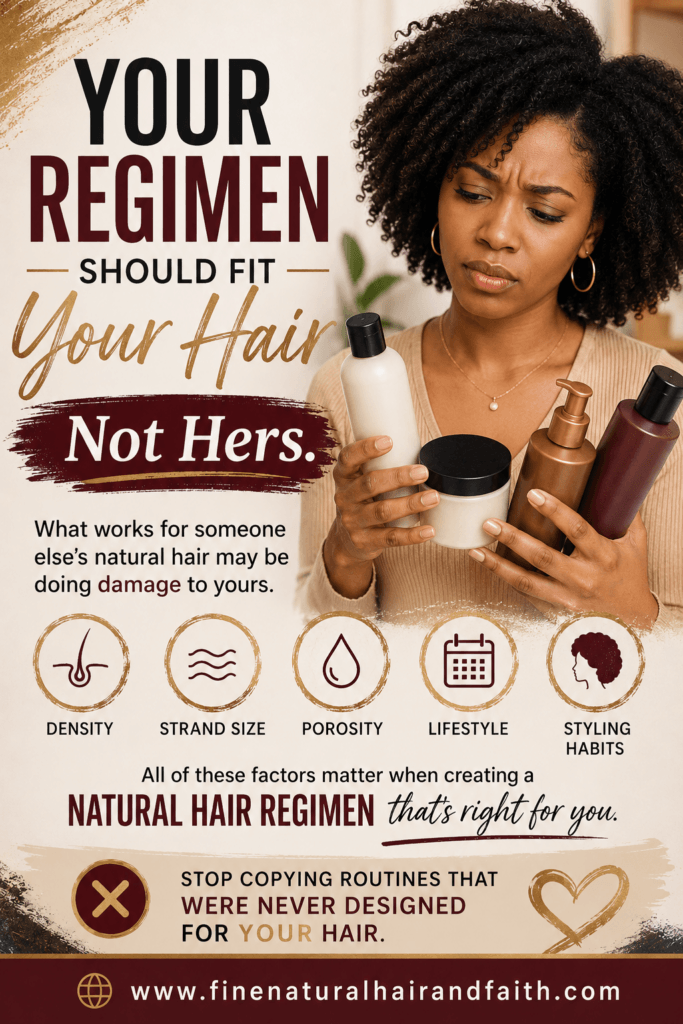
There are so many factors that can affect how one person’s hair responds to different products and techniques. Factors like:
- Hair porosity
- Density
- Strand thickness
- Condition of the scalp
- Curl pattern
For example, what deeply moisturizes one person’s hair can sit on top of the hair shaft of another’s without absorbing at all. What works beautifully for thick, coarse strands can weigh fine strands down completely.
This is why it’s not a good idea to copy someone else’s hair care regimen verbatim.

The Real Cost of a “Borrowed” Regimen
A lot of women spend months and sometimes years cycling through the things that other people do in their hair regimens before realizing the approach doesn’t work for them.
When hair routines don’t seem to work, the instinct is usually to add something: a new product, a new technique, maybe add a few more steps. But more is rarely the answer when the foundation is off.
Without understanding what your hair actually needs, you’re essentially guessing at it, and guessing can get expensive, both in money and in time.
There’s also another cost you may not have considered. A slow erosion of trust in your own hair’s ability can easily creep up. When you keep trying things that don’t work, it’s easy to start believing your hair is the problem. But, I want to clean the slate. Your hair isn’t the problem. You just haven’t found the right routines for your hair. For example, fine natural hair has different characteristics that require a different approach to hair care.
Pay Attention to What Your Hair Is Telling You
Your hair communicates constantly. The challenge is knowing how to read it.
Excessive shedding, persistent dryness, limpness after moisturizing, and breakage at the ends are ways your hair is telling you something is wrong. And they’re almost always pointing to a mismatch between what you’re doing and what your hair actually needs.
Fine natural hair, in particular, has specific needs that generic natural hair advice doesn’t always account for. Fine strands don’t tolerate heavier hair products the way thicker strands can. For example, fine hair needs moisture, but it needs lightweight moisture.
When you understand your hair’s characteristics first, you stop chasing solutions and start making intentional decisions.
What Building a Regimen for Your Own Hair Looks Like
Now, don’t get me wrong. There’s nothing wrong with learning from other people’s hair journeys. Watching someone else’s process can introduce you to products, spark ideas, and remind you that hair growth is possible. The key is to borrow inspiration, not blueprints.
Building a regimen that works for your hair starts with knowing your own hair, not knowing what works for natural hair in general. And, it’s definitely not about knowing what works for someone whose hair looks like yours.
Knowing your hair: its porosity, density, how it responds to protein, how it responds to moisture, what it needs in different seasons, and what it simply cannot tolerate.
For fine natural hair, simpler is usually better. Fewer products used correctly will always outperform a regimen that requires twenty steps. But even minimalism only works when you know what your hair actually needs.
See: Guide to Building Minimalist Fine Natural Hair Routines
The Role Identity Plays in Your Hair Journey
I created what’s called The Faith-Based Natural Hair Framework. The reason I created this is because I was tired of the cookie-cutter natural hair advice that’s out there.
The Identity stage of the Framework isn’t about hair characteristics. It’s about the foundation beneath your hair journey. It’s about how you see your hair, exposing how you feel about it, and whether you’ve developed the confidence to approach caring for your own hair rather than through the lens of comparison.
When you’re constantly chasing someone else’s results, part of what’s happening is comparison. You may have unconsciously decided that “her hair” is the gold standard, and yours is falling short. That internal posture makes it nearly impossible to be objective about what your own hair needs.
Freedom from comparison and confidence rooted in truth is what makes it possible to actually pay attention to and ultimately learn to love your own hair. And when you’re paying attention, the information your hair gives you becomes something you can actually use.
That’s what the Identity stage is designed to build. Explore Identity
Conclusion
So, yes. Her hair care regimen is working for her. And, that’s the whole point.
Some people may be able to grow a long healthy head of hair with little effort. This could be due to strand diameter but more importantly, It’s proof that building from the right foundation is what will produce results.
Your hair isn’t a problem to be solved with someone else’s solution. It’s something worth understanding on its own terms. And once you do, building your natural hair regimen will become a lot less complicated and definitely, a lot less trial and error.

Frequently Asked Questions
A regimen is the totality of all your hair care practices. It’s everything you do to care for your hair rolled up into one. You can have a wash day routine, a specific daily maintenance routine, trimming routine etc. A routine is one series of actions within your entire hair regimen.
Start by learning your own hair’s characteristics, particularly porosity and density. From there, build out your individual hair routines using products suited to those characteristics. A framework-based approach will give you more consistent results than borrowing someone else’s process.
Common signs your regimen isn’t working include persistent dryness even after moisturizing, excessive shedding beyond the normal 50 to 100 strands per day, hair that feels weighed down after product application, and hair breakage that doesn’t improve over time.
Yes. Fine natural hair refers to the diameter of the individual strand. It can be natural if unprocessed with chemical straighteners but it’s the width of an individual strand that makes it different. It’s typically lacking the inner layer that thick hair structures have – the medulla.
Begin with your hair’s characteristics: porosity, density, and texture. Then build a simple foundation that includes cleansing, deep conditioning, moisturizing, and protecting. Look for hair products tailored to your hair’s characteristics. Some basic products you’ll need will be a clarifying or moisturizing shampoo, a deep conditioner, a leave-in conditioner, and hair sealants for your hair type.


