
The 5 Everyday Objects That Wreck Fine Hair
1. Excessive Direct Heat Styling
- touching up frizzy edges with a flat iron
- straightening the leave out section when the rest of your hair is under a weave
What constitutes direct contact?
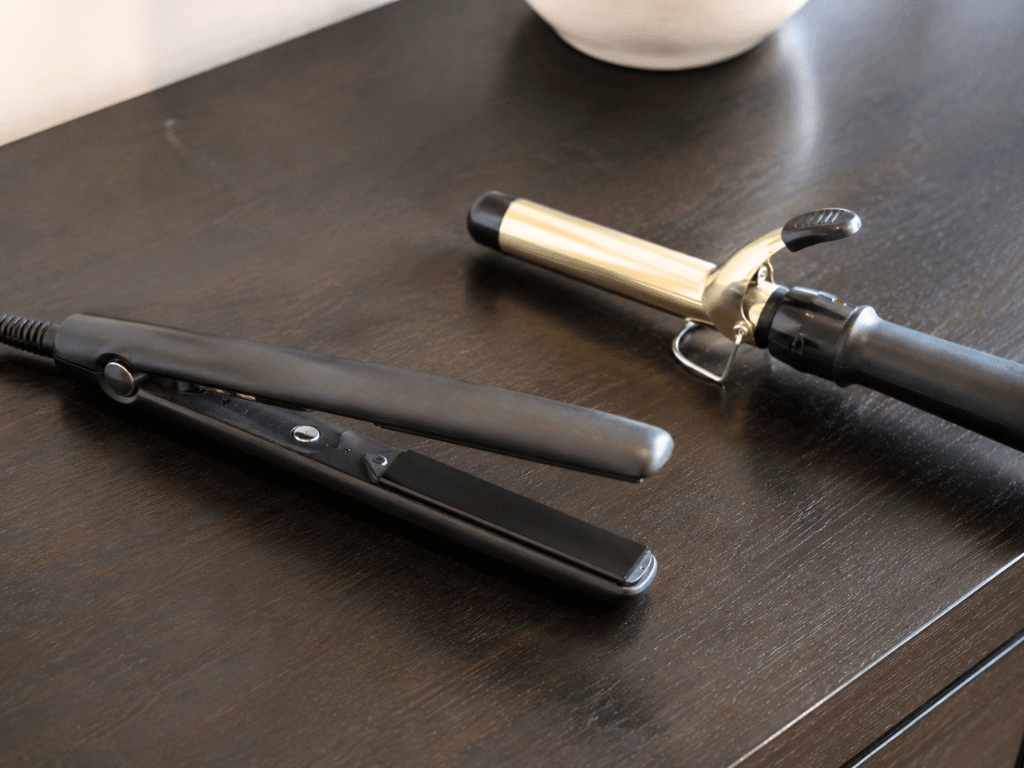
When I say direct contact heat, I’m referring to flat irons, crimping irons, curling irons, and other heat tools that “clamp” the hair between two plates.
Why limit heat styling?
Because fine hair lacks the structural integrity of thicker strands, using direct heat on this hair type can cause serious damage.
Fine hair typically is lacking the innermost layer of other hair types, the medulla.
While the actual purpose of the medulla is unknown, it does serve to provide the hair shaft with a bit more “bulk.” Without the medulla, it’s quite easy for direct heat from an appliance to cause damage.
Safer heat styling tools
To stay that one should “never” use a heat styler on their hair (fine or otherwise), may be unrealistic for some.
I went many years without using direct contact heat stylers on my fine natural hair because I had a length goal and needed my hair to be as healthy as possible. Now that my hair is stronger and longer, I become a straight hair natural and flat iron my hair once a month.
You can have fine hair and straighten your hair. How much heat you use and how often you use it is very important.
In order to be safe when heat styling, the tools I can confidently recommend using are the following:
- A straightening brush that emits steam while straightening. The WavyTalk Steam Pro Straightening Brush is the one that I use. It helps to prevent your hair from drying out when it’s being straightened. Additionally, it doesn’t flatten or mash your hair between two hot plates. Previously, I used the Tymo Hair Straightening brush. I still own this, and it’s quite similar to WavyTalk, but the WavyTalk device has a leg up due to its steam feature.
- A ceramic tourmaline flat iron. This type of flat iron is best because the ceramic distributes heat evenly without creating “hot spots.” The tourmaline technology improves the amount of smoothness when the hair is straightened while reducing static and frizz. This naturally lends toward reducing the number of passes you need to make to get your hair straight. For my fine natural hair, I keep the temperature at 380-390 degrees. Anything higher and the risk of scorching the hair, creating damage is high.
- A blow dryer. These are generally safe because you can control the amount of heat that comes from blow dryers. That heat moves up and down the hair shaft and isn’t concentrated in one spot.
Safest Hair Dryer: RevAir Reverse Air Hair Dryer (Save 10% off the full package with code FINEHAIR10
2. Hair Brushes

The second enemy to fine hair that I recommend avoiding is hair brushes – specifically when your hair is in its curly state. When your hair is straight, there’s less chance of snagging, which could cause damage or breakage.
Now, not all hair brushes are created equal. You can safely use a detangling brush if you are careful. A hair brush like the E-Z Detangler gives with the hair. Of course, you still need to use it with a conditioner containing a good amount of slip. You also need to work with small sections of hair when detangling.
Additionally, wooden/bamboo hair brushes can be safe, but you still need to work from your ends up to ensure tangles are not ripped out of your hair.
Hair brushes containing other bristles should be avoided.
Fine hair is so delicate that pulling a brush containing bristles through your hair can rip your fine strands right out. Trust me. I’ve been there and done that.
Your hair has its own story. The Breakage Detective is a free two-minute tool that pinpoints what’s holding yours back and what to change first.
3. Elastic Bands
Elastics can damage any hair type, but especially fine hair. Specifically, thin elastic bands and those with seams.
If you like to secure your hair with elastic bands, consider using thicker ones that are seamless like these here:


Alternatively, you can secure your hair with a tool like the Puff Cuff or a bungee type elastic with the little hooks on the ends. These are much gentler to your strands.


Not Sure What’s Causing Hair Breakage?
Fine natural hair can break for several reasons, and sometimes it’s hard to pinpoint which part of your routine is causing the problem.
Take the Breakage Detective to uncover potential causes of your breakage and get practical solutions based on your results.
4. Jewelry

If you have fine hair (especially when wearing it out) and it comes in contact with jewelry, the results could be less than desirable.
Fine hair can be easily broken when caught in the clasp of a necklace. Rings and earrings can cause the same issues, making them one of the biggest enemies to fine hair.
So, when wearing jewelry, consider wearing your hair up and out of the way to protect it from getting “caught up” and ripped out.
5. Permanent Hair Color Much Lighter Than Your Own

Last, but certainly not the least of enemies to fine hair, permanent hair color can cause irreparable damage to fine hair.
Permanent hair coloring contains some heavy duty chemicals. When you choose to color your hair (stripping it of its natural color), by lifting it more than two shades from your natural color, damaged hair is the result.
For example, let’s say you have black hair. Then, you dye it blonde. Your hair is now damaged. No amount of deep conditioning will change the state of your hair. It will simply have to grow or be cut out.
I did this many years ago at a salon where they honestly didn’t care about the health of the hair. I deep conditioned and moisturized, and used protein treatments afterwards. Yet, my hair would not respond. It went from healthy to damaged, and no amount of hair treatments would help.



So how do u get the straight look?
Hi Shirley, when I wrote this article I was working toward having healthier hair and at that time, I realized that using direct heat styling hinders the goal. I’ve since incorporated “some” heat styling so while I still think that direct heat styling can not be good for fine natural hair while trying to reach a healthy lengthy goal, I would say that a person can use heat sparingly just not direct contact heat via a flat iron no more than once a year and even then I’d let a professional do it. For at home, I use a steaming straightening brush which adds moisture while straightening.
I’ll update the article for changes
Good evening, my name is Joan, I carry natural hair for a year plus now, at first it was an hairdresser that touched my and I start having itching on my scalp so I stop meeting her to make my hair. Later I discovered that when anybody touched my hair to loose it, to plate it even to wash and apply hair cream, my scalp itch me and after sometime it stop, but anytime I touch it itch.
What do I do, please help me.
I think you need to see a doctor, maybe a dermatologist. It’s not normal to have the constant itching. I’m sorry you are going through this.